
Safe Harbor 401(k): What Insurance Agency Owners Should Review Before Year-End

If your insurance agency already has a safe harbor 401(k), when did you last review it?
Start with your own contribution, what the agency pays for employees, and whether additional profit sharing makes financial sense. You may not need a different plan. You need to know what the current one allows and what changes would cost.
What Safe Harbor Actually Does
In a traditional 401(k), low employee contributions can limit how much owners and other highly compensated employees can contribute through payroll. Failing the annual deferral test can mean returning part of those contributions.
A properly operated safe harbor plan avoids that test in exchange for required employer contributions. That makes your own retirement contributions less dependent on what employees choose to save.
What Does It Cost for Employees?
Two common traditional safe harbor options are:
- 3% nonelective contribution: The agency contributes 3% of eligible pay, whether or not the employee contributes.
- Basic safe harbor match: The agency matches 100% of the first 3% an employee contributes, plus 50% of the next 2%. An employee contributing 5% receives a 4% employer match.
These traditional safe harbor contributions belong to the employee immediately, without a vesting waiting period.
For an employee earning $40,000 in eligible pay, that means $1,200 under the 3% option or a maximum basic match of $1,600. Which formula costs your agency less depends on employee participation.
Before choosing a formula for next year, ask your administrator to compare both using your actual payroll and contribution data.
Check Your Own Payroll Election
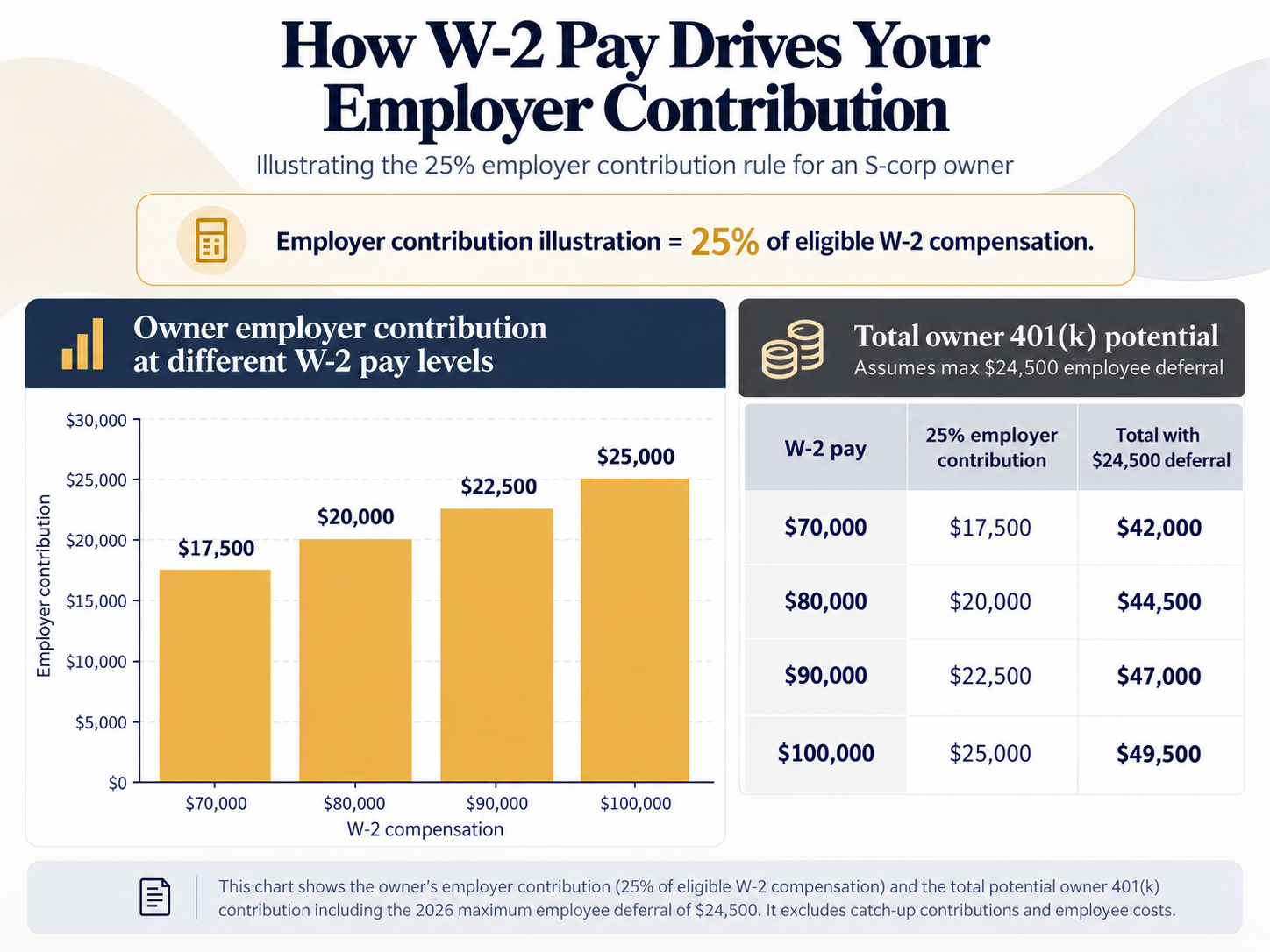
For 2026, the employee deferral limit is $24,500. Eligible participants age 50 or older can generally contribute another $8,000. For those turning 60 through 63 during the year, the catch-up limit is $11,250 instead.
Check what you have contributed so far and what your remaining paychecks will add. A percentage you selected several years ago may no longer reflect what you intend to save.
There is also a 2026 change to watch: if your 2025 wages subject to Social Security tax from the employer sponsoring the plan exceeded $150,000, your catch-up contributions generally must be Roth rather than pre-tax. Confirm that payroll and the plan administrator are handling this correctly.
Could Additional Employer Profit Sharing Make Sense?
Your agency may be able to add an employer profit-sharing contribution beyond the required safe harbor amount.
One approach is new comparability profit sharing, often called cross-tested profit sharing. It allows different contribution percentages for different employee groups, subject to nondiscrimination testing. Depending on employees’ ages and compensation, it may support a higher contribution percentage for owners than for other staff.
But that can require additional employee contributions, too. The 3% safe harbor contribution is not necessarily the full staff cost. A design that works for one agency may not work for another with different ages, salaries, or ownership.
Ask your third-party administrator for an illustration showing how much would go into your account, how much would go to employees, and the agency’s total cost. Then review the tax treatment and cash requirements with your CPA.
For 2026, the overall contribution limit is generally the lesser of $72,000 or 100% of eligible compensation, excluding catch-up contributions. That limit includes your regular deferrals and employer contributions. It is a ceiling, not an amount every owner can automatically reach.
The useful question is not simply, “Can I get to $72,000?” It is, “What would it cost the agency to get there, and does that make sense?”
Check the Deadlines Before Year-End
For an owner paid through payroll, changes to 2026 salary deferrals need to happen before the remaining compensation is paid. Once contributions are withheld, they must be deposited promptly. They cannot sit in the agency’s bank account until tax-filing time.
Employer profit-sharing contributions can generally be funded by the business tax-return deadline, including extensions, and deducted for the prior tax year when the applicable requirements are met. Safe harbor funding, notice, and amendment deadlines can differ, so have your administrator confirm the dates for your plan.
Review the Plan You Already Have
Before year-end, put your payroll election, employee contribution costs, and any proposed profit-sharing allocation in front of your CPA and plan administrator.
You may decide to increase your contribution, change the design for next year, or leave the plan alone. Make that decision with the numbers in front of you.
Have a retirement plan at your agency but no coordinated tax strategy? Book a discovery call to discuss your goals and whether our ongoing tax-planning services are a good fit.

More Tax Planning and Accounting Insights
Explore practical guidance to reduce taxes, improve financial clarity, and make more confident business decisions.